
DeepLocator
Locating submerged fishing gear

Lorem ipsum dolor sit amet, consectetur adipiscing elit. Sed do eiusmod tempor incididunt ut labore et dolore magna aliqua. Ut enim ad minim veniam, quis nostrud exercitation ullamco laboris nisi ut aliquip ex ea commodo consequat. Duis aute irure dolor in reprehenderit in voluptate velit esse cillum dolore eu fugiat nulla pariatur. Excepteur sint occaecat cupidatat non proident, sunt in culpa qui officia deserunt mollit anim id est laborum.
Reactive Recovery
The Redes Fantasma radio system supports both proactive prevention and reactive recovery.
The following applications for the DeepLocator are under development:
Application 1 – Reactive recovery of submerged gear
The challenge is that it is often unclear whether a drifting net will remain afloat or eventually sink. In many cases, someone first attaches a FloatLocator to a freely drifting net to secure its position. When a fisher later reaches the site, they may realize that the net is too heavy to recover alone. If it becomes apparent that the net is likely to sink, the fisher can attach a DeepLocator as an additional safety measure. Nets may sink, for example, when floats are missing, the gear is heavily weighted, or marine growth has reduced buoyancy. This ensures that the net can still be found and recovered later, even if it disappears below the surface.
The DeepLocator is designed for gear that sinks below the surface, such as cages or nets. It is attached to the gear and descends together with it. After a predefined time, the transmitter is released, rises to the surface and starts transmitting its position. The transmitter remains connected to the submerged gear by a thin filament acting as an “Ariadne’s thread”. This allows the location of the gear itself, not just the floating transmitter.
Recovering submerged gear is significantly more complex than retrieving floating gear. The filament therefore supports targeted recovery by divers or remotely operated underwater vehicles (ROVs).
Finding is not the finish line. Recovery is. The DeepLocator therefore does not chase depth records: its tether ends where realistic recovery ends.

The DeepLocator is getting attached to a drifting piece of gear (cage, net or other). This can be done by anyone, not just fishermen.
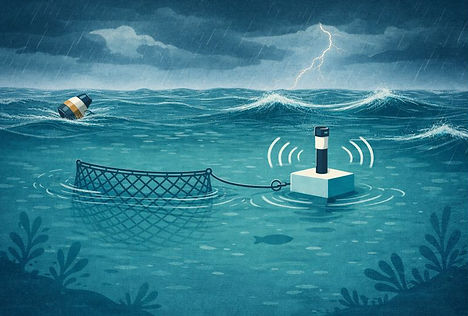

When the gear sinks, the DeepLocator sinks with it.

After a predefined time, the DeepLocator emerges automatically to the surface and sends a signal. The net can be found and recovered.

For those interested in the technical challenges, solutions and implementation details, we welcome inquiries via the contact form.
Read also about the FloatLocator.